All About Consent

“Consent is a Freely Given, Knowledgeable and Informed Agreement, by a person with the capacity to reason!"

Consent could be the most misunderstood word in our justice system!

When Bill Cosby’s Pennsylvania jury asked for the definition for “consent” in Andrea Constand’s case, Judge Steven O’Neill told them, “That’s a question that cannot be answered. You’re reasonable people. Use your common sense!”

When New York’s Weinstein jurors asked for the definition for “consent” in the cases of Miriam Haley and Jessica Mann, Judge James Burke said. “Use your common sense.”

The state of New York and the Commonwealth of Pennsylvania are only two of the countless, consent-blind states across the US and additional jurisdictions around the world. While the jurors returned guilty verdicts, those decisions were overturned by the respective Court of Appeals in their states. The overturn of these cases demonstrates that since consent is not germane in establishing guilt or innocence, sexual assault and rape verdicts are frequently overruled.

Society, YOU, can change the egregious flaws in our laws! CAN is fighting to do exactly that!
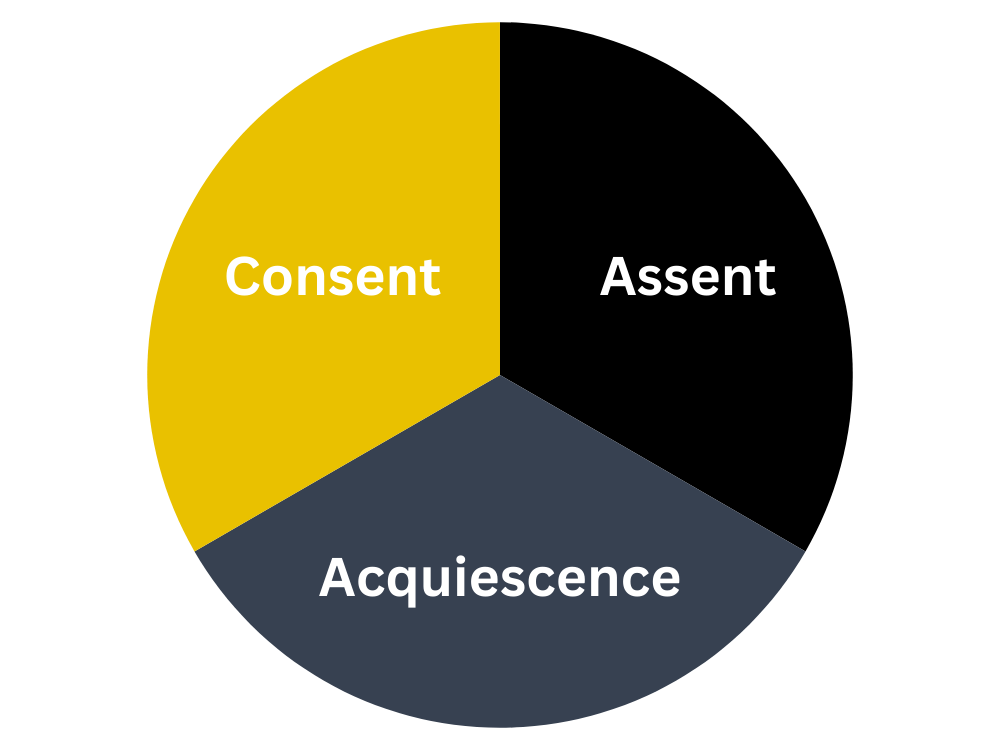
Types of Agreement

What is consent?

Consent, #FGKIA is a noun. It means: Freely Given, Knowledgeable and Informed Agreement, by a person with the capacity to reason!

What is assent?

Assent is agreement “on the face of it.” No matter what caused an individual to agree and no matter what caused them to comply, the mere nodding of the head or saying “yes” indicates they are assenting. Assent does not carry the same weight as “consent.” The causation of a person’s agreement must be a consideration in consent, but not in assent. In all crimes, including sex crimes, consent is determined by the type of influence that is used to secure compliance.

What is acquiescence?

Acquiescence is agreement or compliance under duress. Securing compliance through fear is acquiescence but not consent.

Consent, the Noun

Consent is #FGKIA: Freely Given, Knowledgeable and Informed Agreement, by a person with the capacity to reason!

To Consent, the Verb

The conveyance of consent.

Reverse

Reverse literally means to “call back.” It is as if the consent never existed.

Reverse vs Revoke

To reverse an agreement means to remove the agreement’s existence. When “revoked,” the consent that exists is being withdrawn.

Mutual

Consent is a highly individual right. Because consent is individual, not mutual, either party can revoke their consent. In situations where the consent of two parties needs to take place simultaneously, either can revoke their consent. In mutual agreements, however, both parties would need to agree to the revocation in order to end the agreement. For this reason, considering consent as “mutual” in sexual conduct, instead of individual and simultaneous, is an adverse and dangerous concept.

Simultaneous

Simultaneous means “in unison.”

How should consent apply in the penal code?

Presently, our penal laws embed blame-the-victim language into their sex crime statutes, including that the “words and actions” of the victim determines whether consent took place or not. This archaic misconception incorrectly places blame on the victim’s shoulders by ignoring that when someone uses malicious influence such as force, fear, fraud, or the exploitation of their target’s incapacity in order to secure agreement or compliance, no matter what that person says or does, and no matter how emphatically they speak or comply, they are not consenting.

Our laws currently focus on the conveyance of consent, the verb, not what consent, the noun actually means. The words and actions of the victim can only convey consent if freely given, knowledgeable and informed agreement by a person with the capacity to reason was actually taking place.

While our laws prohibit character attacks against the accused, they enable and invite character assassination of the victim by focusing on the conveyance of consent instead of the content of consent.

The 2024 Weinstein verdicts in NY City were overturned because the appeals court determined that the inclusion of Molineux witnesses tainted Mr. Weinstein’s character, rendering a verdict based on his character instead of his conduct at the time of the act.

Modern science has shown that victims will behave in ways unlike the typical myths we associate with sex crimes. They will often try to regain normalcy in their lives, even to the extent of continuing relationships with the person who assaulted them.

Without a definition to specifically center the case on the influence used to secure compliance, prosecutors are continuously forced to conduct prosecutions in ways that create mistrials, inconsistent determinations, and overturns of guilty verdicts. Victims fear having their character ripped to shreds by the justice process, and sexual predators will be emboldened to harm victim after traumatized victim.

Your Consent: The Key to Conquering Sexual Assault

Malicious influence, not the words and actions that result from malicious influence, are the determining factor between guilt or innocence in an enlightened courtroom.

Consent is a unique and specialized form of “agreement.”

The accurate definition for consent is supported by Canon Law, Model Penal Code, Nuremberg Code, General Data Protection Regulation (GDPR), Voting Rights Law, and more.

Buy the Book

From Our Fellow Consent Crusaders...

“CAN is an eye opener that can turn our human right of consent into a civil right backed by law.”

Andrea Constand
State’s Witness in Bill Cosby Indecent Assault case, Pennsylvania 2018

“This small but crucial addition to our lawbooks could make all the difference for sexual assault survivors as they grapple with the legal proceedings and raise the public’s awareness, in an effort to prevent crimes involving sexual contact.”

Miriam Haley
State’s Witness in Harvey Weinstein’s Criminal Sexual Assault case, New York 2020

All legal and law enforcement should “read this compelling book on consent and become a voice for change.”

Steve Bishop
Detective, Colorado Law Enforcement

Frequently Asked Questions About Consent

What is consent?

Consent is #FGKIA: Freely Given, Knowledgeable and Informed Agreement, by a person with the Capacity to Reason!

Is silence or lack of resistance the same as consent?

No. Silence, passivity, or lack of resistance does not constitute consent.

Can someone give consent if they’re under the influence of drugs or alcohol?

While technically, the answer is emphatically NO, jurisdictions differ widely on this issue. Some recognize that a person who is incapacitated by drugs or alcohol cannot give consent. Others only prosecute if the person is rendered incapacitated without their knowledge.

In fact, Texas recently changed their law on this very issue. A woman was raped at a fraternity when one man administered a drug and a different man sexually assaulted her. The Texas laws at the time did not include that two different men could carry out the offense. Fortunately, due to the determined advocacy of the brave victim in this case, Texas penal law was subsequently revised and now states that sexual conduct with an incapacitated victim is a sex crime.

Does consent once mean consent always?

No. Consent does not carry over to additional sexual conduct.

What does “informed consent” mean?

“Informed consent” is redundant and implies that there are many types of “consent.” By its very nature consent is always informed. Agreements that are not based on the #FGKIA principles – which include being informed – are not consent. Uninformed agreement would qualify as assent, but not consent. “Uninformed consent” would be an oxymoron.

Understanding Consent: Rewriting the Narrative for Justice and Empowerment

Consent isn’t just a moment—it’s a movement. At the Consent Awareness Network (CAN), we believe that true empowerment begins with a clear understanding of consent, autonomy, and human dignity. Our blog is dedicated to exploring the urgent need for legal reform, survivor advocacy, and public education around consent. Here, we share stories, insights, interviews, and updates that challenge outdated systems and elevate voices demanding change. Whether you’re new to this conversation or a long-time advocate, this space is for deepening your awareness and taking action.

Read More